Fairytale

Towards Life

Samara Sallam

Contemplative Rituals

Storytelling

Folktales

Hypnosis as Liberation

Contemporary Art

Folktale Fiction

Folktale Fiction

Fairytale

More-Than-Human Models

Speculative Repair

Leadership

Samara Salam

Reimagining Community & Repair

Sculptor and hypnotherapist Samara Sallam employs language not only as a tool of communication, but as a force that moves and alters our worlds and bodies. Creating carefully crafted physical objects, her work commands transcendence and contemplation — seeking meaning in a world of violence by outlining liminal spaces between the magical and the real.

Here, Samara Sallam expands on her thought process and artistic practice. Focusing on the development of fiction to material realities and expressions, she lingers on hypnosis as a tool of liberating the imagination.

“I am very interested in imagining the future collective psychological landscape, examining the conditions and methods that can strengthen the resilience of our psyche amid rapid geopolitical shifts and climate-related pressures, especially in our SWANA region.  My long-term project draws on hypnotherapy, Jungian psychoanalysis, and Sufi philosophy, unfolding through both sculptural and fictional text forms. In my current project, I am using the novella as a starting point, from which I will develop a practice of world-building in sculptural form. I want to employ new approaches to art exhibitions where imagination is activated by the novel.”

– Samara Sallam


Q:  Your project sounds wonderful and eye-opening. I really appreciate your usage of a meta approach to writing the novella and tackling its main themes. Can you expand more on how you're planning on using hypnotherapy to reach the textual/fictional terrains that you will be working with? Are there any inspiring texts and images that you rely on towards the completion of this project? Tell us more about your agile transgression of mediums, from the physical (sculpture) to the metaphysical/fictional (folktales/novellas). How do you decide on a medium? And how does this traveling between mediums inform your practice and enrich the liberatory spaces that are possible because of this transgression? Do you feel like this opens the capacity to imagine beyond the (often oppressing) reality?

Samara: I’m excited for this conversation and to share my practice with you. I’m also hoping it will challenge my language, especially the art scene language that has started to feel a bit limited for what I’m trying to create and bring into reality.

My work with hypnotherapy and hypnotic performance has, from the beginning, illuminated parallels with the structural techniques found in folk stories. My research has always been embodied, and I found relevant literature among those who wrote about myths and folk narratives in connection with spiritual transformation, like Joseph Campbell, Carl Jung and his student Marie-Louise von Franz. Their work often connects myth with deep mystical knowledge. In my research, I found that hypnosis techniques used to alter states of consciousness are also within myths and folk stories. I realized that the visual language of folk narratives is the language of the subconscious, related to the language of dreams, yet quite different. It’s an entirely other form of communication, one that can only be fully decoded when in a trance. It speaks to a level of communication that the art world is constantly trying to reach. What we call “great art,” in my opinion, is simply art that succeeds in communicating at that level, art that speaks directly to the collective subconscious.

When I use hypnosis to enter the subconscious without the judgment of the conscious mind, everything related to ordinary reality disappears, including the sense of space and time. This is why skilled meditators can spend hours in meditation with no awareness of how much time has passed. The same applies to language: the dialogue between the self and the “other-self” in the subconscious realm is not linguistic; it is symbolic, visual, energetic, emotional, or even purely thought-based language. Understanding this new language and its codes opens up an entire universe, like learning a completely new system of communication.

Because of all this, the medium through which I express ideas is not fixed. It shifts depending on what best fits the concept or the internal logic of the work. It could be a physical material, or text, or performance, or film, anything, as long as I’m using the appropriate elements to construct the body of the sculpture, the text, or the experience. I definitely enjoy certain qualities of particular media more than others, but that’s a different conversation.

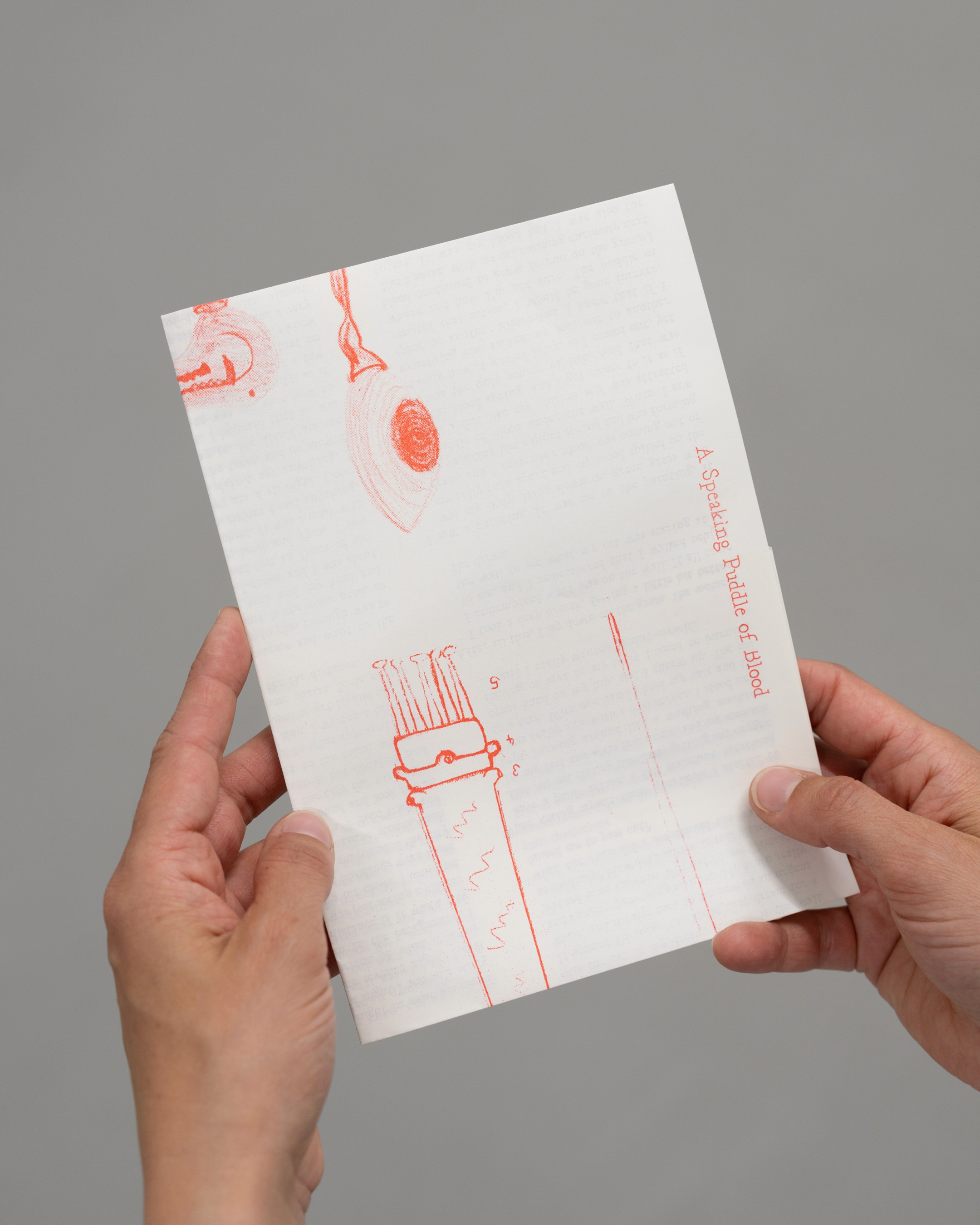
In my last show, a speaking puddle of blood*1, I started with my research on folk stories, I then looked at my own mystical journey towards meaning, and based on my own psychic experiences, I made the sculptures. When I finished installing the sculptures in the space, I wrote a fictional story based on the sculptures themselves. It was a long, interesting exercise where I shifted from microcosm to macrocosm, and then to microcosm again. I don't know if I shared the story with you before. I'm sending it here. I guess if you see the works and sit with them in the room, then read the story, some symbolic language unfolds, like a world built tight. 
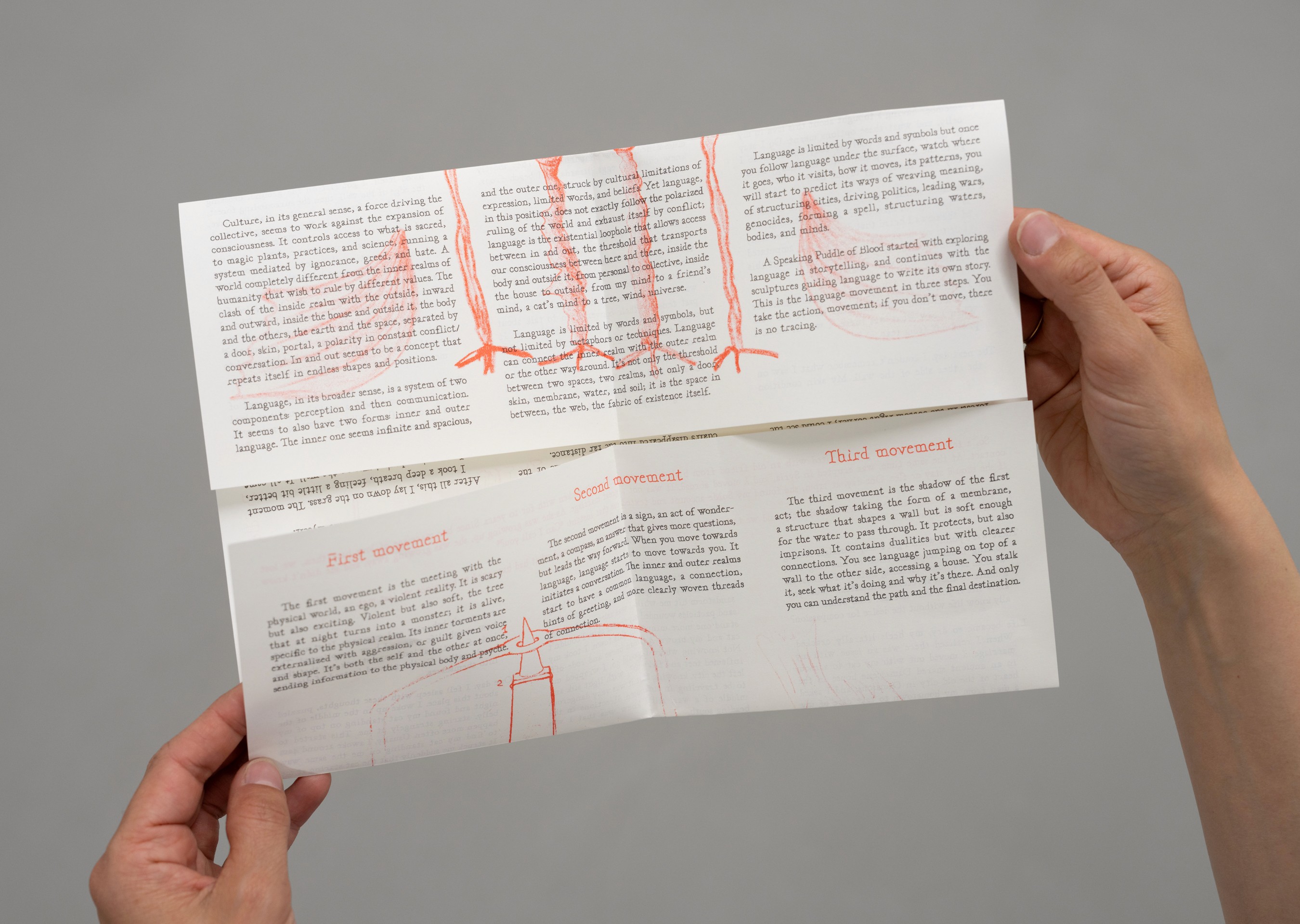

Artwork: A Speaking Puddle of Blood, Samara Sallam, Overgaden.
Photo by David Stjernholm
Artwork: A Speaking Puddle of Blood, Samara Sallam, Overgaden.
Photo by David Stjernholm

Q: It's wonderful to hear about your practice and the thought process that goes into it. Can you tell me more about your process; specifically, about using one of the liberation fiction tools in your practice? Perhaps you can expand on how you use hypnosis or fiction methodologically towards arriving at these open imaginative spaces?


Samara: I have been writing more; maybe I'm looking for some liberation of what is going on in the world, as well as inside my psyche, through writing.

After a few years of practicing hypnosis, things shift; it moves from being a method to enter the subconscious through calculated steps and techniques to a skill of initiating that space with not so much effort, and that's what I do when writing or making art. 

For example, to understand hypnosis techniques is to create a condition to trick the conscious mind, which is thinking, judging, and analysing the current moment, by creating a linguistic pattern of words. After a while, the brain starts to analyse this pattern as a sound pattern instead of words that carry meaning; it becomes just sounds. That's the moment we call hypnosis: in this moment you can ask the subconscious for information about a certain matter, and the subconscious will answer because the conscious mind, which is considered the defence mechanism, was tricked and bypassed. This technique could also be used to install new ideas or a new perspective on things. That's why it is considered a therapy practice, where it can break stuck behavioural patterns. 

This is one technique that fictional literature can borrow and use to allow the reader to immerse in the universe of the story, and maybe, in that space, offer something more to the reader, or install new ideas. 

This sounds dangerous, but it is important to understand that hypnosis is unable to change core values in people. Values in the Western psychological understanding are located in the unconscious, which is a different space than the subconscious that holds long-term memory, emotions, and creativity.


Q: It's wonderful to hear about your practice and the thought process that goes into it. Can you tell me more about your process; specifically, about using one of the liberation fiction tools in your practice? Perhaps you can expand on how you use hypnosis or fiction methodologically towards arriving at these open imaginative spaces?


Samara: I have been writing more; maybe I'm looking for some liberation of what is going on in the world, as well as inside my psyche, through writing.

After a few years of practicing hypnosis, things shift; it moves from being a method to enter the subconscious through calculated steps and techniques to a skill of initiating that space with not so much effort, and that's what I do when writing or making art. 

For example, to understand hypnosis techniques is to create a condition to trick the conscious mind, which is thinking, judging, and analysing the current moment, by creating a linguistic pattern of words. After a while, the brain starts to analyse this pattern as a sound pattern instead of words that carry meaning; it becomes just sounds. That's the moment we call hypnosis: in this moment you can ask the subconscious for information about a certain matter, and the subconscious will answer because the conscious mind, which is considered the defence mechanism, was tricked and bypassed. This technique could also be used to install new ideas or a new perspective on things. That's why it is considered a therapy practice, where it can break stuck behavioural patterns. 

This is one technique that fictional literature can borrow and use to allow the reader to immerse in the universe of the story, and maybe, in that space, offer something more to the reader, or install new ideas. 

This sounds dangerous, but it is important to understand that hypnosis is unable to change core values in people. Values in the Western psychological understanding are located in the unconscious, which is a different space than the subconscious that holds long-term memory, emotions, and creativity. Hypnosis mostly works with the subconscious. There are techniques to work with the unconscious, but it's not taught in hypnosis schools and only spiritual masters know how to work with it. 

To go back to the linguistic patterns, in folk stories, there are several techniques for achieving this effect. This could be with the beginnings of the story that in Arabic you call الحكاية سجادة (sijjadat al-hikaya), a term I learnt from a Palestinian storyteller in Amman. It's the beginning of the story that attracts the listener and allows them to relax into listening to the story. Also, another technique is having repetitive chapters, a song, or certain words. 

This is just a general explanation, how I use this knowledge is now a bit intuitive, as I said in the beginning. I try to create a similar trick visually with the exhibition room, how you enter the space, and what is the first thing you see, and how the rest of the show unfolds. 

Another important note in storytelling practices to keep in mind is to balance how many details you directly tell and how much you leave for the receiver's imagination to continue the image or the scene. I also use this in the visual sculptures or installations I make. I work with symbols and signs to convey a meaning just as language functions, and I tell part of the story and allow the visitors to complete it. 

I'm trying to simplify the process here, but I believe that offering such visual space with those characteristics is somehow a way to resist and a way to liberate imagination. In my work, I try to include a multi-layered system of semiotics. If the visitors are aware of those dynamics, then they can sit more with the work and do the meditation that will open deeper layers of imagination, even though I'm aware that this requires a witch to notice hehehe. 


______________________________________________


In this project presented at Overgaden (Copenhagen, DK) Sallam reworks various sources—including her native Palestinian folktale archetype of the girl Ghoul, a flesheating monster who devours her family and destroys her whole village, as well as Sufi mysticism and Jungian psychoanalysis—into a story of finding “meaning,” unfolding in three acts:

i. The first sculpture is a meticulously carved wooden portal. Rich with symbols— breasts, devilish horns, and five legs—the tall arch forms a body, a material manifestation of a monster or ghoul that casts a creation spell on any visitor passing through it.

ii. The second sculpture is a small, dead, open-bellied raven. The ceramic bird acts as a compass or an omen—the all-seeing messenger.

iii. The third sculpture is a fragmented, hypnotic fish head—an ancient symbol of wisdom and transition. The eyes, mouth, and gills in glazed ceramic engage the viewer’s imagination in order to assemble the parts into a fish, pointing, as the exhibition’s third portal or shadow membrane, to another level of consciousness.

A fourth element in the exhibition is a text: a subconscious mind trip of a woman escaping a deadlock marriage, becoming a speaking puddle of blood. While silent, almost withdrawn in appearance, Sallam’s trio of sculptures— combining inherent violence and existential quests—forms a metaphor of the current, ceaseless attacks on the Palestinian people, connecting to a universal or mythical place of suffering.


Hypnosis mostly works with the subconscious. There are techniques to work with the unconscious, but it's not taught in hypnosis schools and only spiritual masters know how to work with it. To go back to the linguistic patterns, in folk stories, there are several techniques for achieving this effect. This could be with the beginnings of the story that in Arabic you call الحكاية سجادة (sijjadat al-hikaya), a term I learnt from a Palestinian storyteller in Amman. It's the beginning of the story that attracts the listener and allows them to relax into listening to the story. Also, another technique is having repetitive chapters, a song, or certain words. 

This is just a general explanation, how I use this knowledge is now a bit intuitive, as I said in the beginning. I try to create a similar trick visually with the exhibition room, how you enter the space, and what is the first thing you see, and how the rest of the show unfolds. 

Another important note in storytelling practices to keep in mind is to balance how many details you directly tell and how much you leave for the receiver's imagination to continue the image or the scene. I also use this in the visual sculptures or installations I make. I work with symbols and signs to convey a meaning just as language functions, and I tell part of the story and allow the visitors to complete it. 

I'm trying to simplify the process here, but I believe that offering such visual space with those characteristics is somehow a way to resist and a way to liberate imagination. In my work, I try to include a multi-layered system of semiotics. If the visitors are aware of those dynamics, then they can sit more with the work and do the meditation that will open deeper layers of imagination, even though I'm aware that this requires a witch to notice hehehe*


Q: It's wonderful to hear about your practice and the thought process that goes into it. Can you tell me more about your process; specifically, about using one of the liberation fiction tools in your practice? Perhaps you can expand on how you use hypnosis or fiction methodologically towards arriving at these open imaginative spaces?


Samara: I have been writing more; maybe I'm looking for some liberation of what is going on in the world, as well as inside my psyche, through writing.

After a few years of practicing hypnosis, things shift; it moves from being a method to enter the subconscious through calculated steps and techniques to a skill of initiating that space with not so much effort, and that's what I do when writing or making art. 

For example, to understand hypnosis techniques is to create a condition to trick the conscious mind, which is thinking, judging, and analysing the current moment, by creating a linguistic pattern of words. After a while, the brain starts to analyse this pattern as a sound pattern instead of words that carry meaning; it becomes just sounds. That's the moment we call hypnosis: in this moment you can ask the subconscious for information about a certain matter, and the subconscious will answer because the conscious mind, which is considered the defence mechanism, was tricked and bypassed. This technique could also be used to install new ideas or a new perspective on things. That's why it is considered a therapy practice, where it can break stuck behavioural patterns. 

This is one technique that fictional literature can borrow and use to allow the reader to immerse in the universe of the story, and maybe, in that space, offer something more to the reader, or install new ideas. 

This sounds dangerous, but it is important to understand that hypnosis is unable to change core values in people. Values in the Western psychological understanding are located in the unconscious, which is a different space than the subconscious that holds long-term memory, emotions, and creativity. Hypnosis mostly works with the subconscious. There are techniques to work with the unconscious, but it's not taught in hypnosis schools and only spiritual masters know how to work with it. 

To go back to the linguistic patterns, in folk stories, there are several techniques for achieving this effect. This could be with the beginnings of the story that in Arabic you call الحكاية سجادة (sijjadat al-hikaya), a term I learnt from a Palestinian storyteller in Amman. It's the beginning of the story that attracts the listener and allows them to relax into listening to the story. Also, another technique is having repetitive chapters, a song, or certain words. 

This is just a general explanation, how I use this knowledge is now a bit intuitive, as I said in the beginning. I try to create a similar trick visually with the exhibition room, how you enter the space, and what is the first thing you see, and how the rest of the show unfolds. 

Another important note in storytelling practices to keep in mind is to balance how many details you directly tell and how much you leave for the receiver's imagination to continue the image or the scene. I also use this in the visual sculptures or installations I make. I work with symbols and signs to convey a meaning just as language functions, and I tell part of the story and allow the visitors to complete it. 

I'm trying to simplify the process here, but I believe that offering such visual space with those characteristics is somehow a way to resist and a way to liberate imagination. In my work, I try to include a multi-layered system of semiotics. If the visitors are aware of those dynamics, then they can sit more with the work and do the meditation that will open deeper layers of imagination, even though I'm aware that this requires a witch to notice hehehe. 


______________________________________________


In this project presented at Overgaden (Copenhagen, DK) Sallam reworks various sources—including her native Palestinian folktale archetype of the girl Ghoul, a flesheating monster who devours her family and destroys her whole village, as well as Sufi mysticism and Jungian psychoanalysis—into a story of finding “meaning,” unfolding in three acts:

i. The first sculpture is a meticulously carved wooden portal. Rich with symbols— breasts, devilish horns, and five legs—the tall arch forms a body, a material manifestation of a monster or ghoul that casts a creation spell on any visitor passing through it.

ii. The second sculpture is a small, dead, open-bellied raven. The ceramic bird acts as a compass or an omen—the all-seeing messenger.

iii. The third sculpture is a fragmented, hypnotic fish head—an ancient symbol of wisdom and transition. The eyes, mouth, and gills in glazed ceramic engage the viewer’s imagination in order to assemble the parts into a fish, pointing, as the exhibition’s third portal or shadow membrane, to another level of consciousness.

A fourth element in the exhibition is a text: a subconscious mind trip of a woman escaping a deadlock marriage, becoming a speaking puddle of blood. While silent, almost withdrawn in appearance, Sallam’s trio of sculptures— combining inherent violence and existential quests—forms a metaphor of the current, ceaseless attacks on the Palestinian people, connecting to a universal or mythical place of suffering.


If this exchange has caught your imagination, we invite you to further dig into Samara’s world.

⇒ read more of Samara’s writing here, and read a brief introduction and contextualisation note to a novella-yet-to-come

by clicking here. Be patient, the novella might decide to appear on this portal, or in a far-away land, one day…


If this exchange has caught your imagination, we invite you to further dig into Samara’s world.

⇒ read more of Samara’s writing here, and read a brief introduction and contextualisation note to a novella-yet-to-come

by clicking here. Be patient, the novella might decide to appear on this portal, or in a far-away land, one day…


*In this project presented at Overgaden (Copenhagen, DK) Sallam reworks various sources—including her native Palestinian folktale archetype of the girl Ghoul, a flesheating monster who devours her family and destroys her whole village, as well as Sufi mysticism and Jungian psychoanalysis—into a story of finding “meaning,” unfolding in three acts:

i. The first sculpture is a meticulously carved wooden portal. Rich with symbols— breasts, devilish horns, and five legs—the tall arch forms a body, a material manifestation of a monster or ghoul that casts a creation spell on any visitor passing through it.

ii. The second sculpture is a small, dead, open-bellied raven. The ceramic bird acts as a compass or an omen—the all-seeing messenger.

iii. The third sculpture is a fragmented, hypnotic fish head—an ancient symbol of wisdom and transition. The eyes, mouth, and gills in glazed ceramic engage the viewer’s imagination in order to assemble the parts into a fish, pointing, as the exhibition’s third portal or shadow membrane, to another level of consciousness.

A fourth element in the exhibition is a text: a subconscious mind trip of a woman escaping a deadlock marriage, becoming a speaking puddle of blood. While silent, almost withdrawn in appearance, Sallam’s trio of sculptures— combining inherent violence and existential quests—forms a metaphor of the current, ceaseless attacks on the Palestinian people, connecting to a universal or mythical place of suffering.


*In this project presented at Overgaden (Copenhagen, DK) Sallam reworks various sources—including her native Palestinian folktale archetype of the girl Ghoul, a flesheating monster who devours her family and destroys her whole village, as well as Sufi mysticism and Jungian psychoanalysis—into a story of finding “meaning,” unfolding in three acts:

i. The first sculpture is a meticulously carved wooden portal. Rich with symbols— breasts, devilish horns, and five legs—the tall arch forms a body, a material manifestation of a monster or ghoul that casts a creation spell on any visitor passing through it.

ii. The second sculpture is a small, dead, open-bellied raven. The ceramic bird acts as a compass or an omen—the all-seeing messenger.

iii. The third sculpture is a fragmented, hypnotic fish head—an ancient symbol of wisdom and transition. The eyes, mouth, and gills in glazed ceramic engage the viewer’s imagination in order to assemble the parts into a fish, pointing, as the exhibition’s third portal or shadow membrane, to another level of consciousness.

A fourth element in the exhibition is a text: a subconscious mind trip of a woman escaping a deadlock marriage, becoming a speaking puddle of blood. While silent, almost withdrawn in appearance, Sallam’s trio of sculptures— combining inherent violence and existential quests—forms a metaphor of the current, ceaseless attacks on the Palestinian people, connecting to a universal or mythical place of suffering.

About Samara
Samara Sallam, a Palestinian born in Damascus in 1991, trained as a visual artist, journalist, and hypnotherapist. Through multi-layered narratives, Sallam investigates the social, cultural, and political intersections of language, biopolitics, psyche, and storytelling. Some artworks can be interpreted through the concept of interactivity as her objects and installations depend on the viewer to interact by touching, eating, or moving the artwork to complete the idea.

Create a free website with Framer, the website builder loved by startups, designers and agencies.